Sets and the City: Proscenium arches give different views
Written by
By James Hadley in London
In my job at Arts Council England I spend a lot of time assessing 'Grants for the Arts' applications. It's a scheme similar to applying for project funding from Creative New Zealand, except due to the scale of activity in London, proposals are assessed by a panel every week. Frequently applicants will be applying to stage a production in a venue I've barely heard of - I hadn't realised just how many theatre venues there are in London. So I'm currently on a mission to familiarise myself with as many London theatres as I can... and that's a great excuse to see a broad variety of the theatre that's on offer in greater London.By James Hadley in London
In my job at Arts Council England I spend a lot of time assessing 'Grants for the Arts' applications. It's a scheme similar to applying for project funding from Creative New Zealand, except due to the scale of activity in London, proposals are assessed by a panel every week. Frequently applicants will be applying to stage a production in a venue I've barely heard of - I hadn't realised just how many theatre venues there are in London. So I'm currently on a mission to familiarise myself with as many London theatres as I can... and that's a great excuse to see a broad variety of the theatre that's on offer in greater London.This week's biggest discovery has been the Theatre Royal Stratford East - which was famous in the '50s and '60s for being the home of Joan Littlewood and Gerry Raffles' Theatre Workshop Company. Probably their most famous production was the musical 'Oh! What a Lovely War' (later turned into an all-star film by Michael Attenborough) - and there are photos and a costume from this show in the foyer. It's a beautiful old Victorian proscenium arch theatre, with three tiers of audience, but on quite a modest scale compared to most proscenium arch theatres - think of Wellington's St James Theatre shrunk down to a third of the size. This gives it a comparatively intimate feel. In fact, the friendly atmosphere of the theatre bar - filled with old black and white photos of shows from 50 years ago, amidst drinkers, diners and a jazz singer - carries over into the auditorium, so it feels more like a community venue than any other pros arch theatre I've been to.
I was there to see the new musical Come Dancing by Ray Davies, lead singer of '60s band The Kinks. Ray Davies narrates the show in direct address to the audience. It's quite a personal story about his family's Saturday night outings to the Ilford Palais, a dance hall in London's East End where everyone would dress up to the nines to dance to what we would now call 'Easy Listening'. They'd recreated the interior of a '50s dance hall onstage, complete with working bar, and audience were encouraged to dance onstage before the show or during the interval, with some watching the performance from cabaret-style seating at tables onstage.
The musical focuses on a moving romance between the narrator's younger sister and an ostracised saxophonist from Jamaica, against the background of rock and roll emerging to spell an end to the more family oriented era that preceded it. The songs are a mix of '50s rock'n'roll, soul and pop music of the time, all written by Davies, and it adds up to a huge nostalgia trip for anyone who was alive in that era - the ones who were dancing in the aisles by the end of the show.
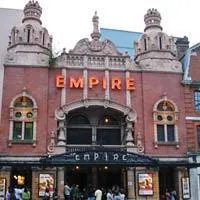
Another proscenium arch venue I attended recently, for a very different show, was the Hackney Empire. This beautiful big red brick Victorian venue is hugely ornate inside and out, and situated on a rough and bustling high street in one of London's most culturally diverse areas - as is also the case with Stratford East in London's East End. This was where I went to see a new play called Gone Too Far by Bola Agbaje. It premiered at the Royal Court Theatre - a smaller venue than the Hackney Empire, where it won an Olivier Award for Outstanding Achievement.
This is the playwright's first play, and a wonderful reflection of the confusions around cultural identity that many young Londoners feel, raised here with limited connection to the culture of their parents. Agbaje is of Nigerian descent, and movingly portrays the relationship between two Nigerian cousins on a London housing estate - one of whom has lived in London all his life, the other having just arrived. The portrayal of how quickly simple cultural misunderstandings can escalate into antagonism on the street was powerfully stated by a scene where a little old lady thought the recent immigrant was trying to mug her, when really he was offering her a seat.
Sitting in an audience that I would estimate was, unusually, about 80% Black British - reflecting something of the local demographic, there were wonderful responses to a scene when several young people of different African or West Indian heritage started trading insults about each other's ethnic origins. People really got stirred up, and it felt exciting because you rarely hear honest conversations in public here that relate to ethnicity. It's such charged territory that most avoid it - so it makes for good theatre. Particularly when it's putting something that seems close to the London you see on the streets up on stage, which is all too rare. Slick scene changes where performers suddenly slipped into slow motion choreography to loud bursts of hip hop added to the streetwise feel of the production.
Another proscenium arch was found at the Lyric Hammersmith Theatre in West London. You move through a very urban chic, minimalist white and metal foyer area, before finding yourself in another traditional proscenium arch-dominated auditorium. Here I got to see a show that had premiered in the Edinburgh Festival while I'd been up there for the Fringe; 365 by David Harrower (of 'Blackbird' fame). This was commissioned by the National Theatre of Scotland, the non-venue based company who impressed many with their world tour of 'Black Watch'. '365' was directed by the company's Artistic Director, Vicky Featherstone.
It's based on the experiences of young Scots growing up in care who are then moved into 'practice flats' when they're old enough - somewhere to adjust to fending for themself in the wider world. It's had mixed reviews, and feels like a piece of verbatim theatre, with a montage of various character monologues and dialogues that don't join together into one overall play in some opinions. But it's performed with such relish by a talented young cast, and gives another underrepresented viewpoint on contemporary Britain. There were moments of magic realism in the staging - characters suddenly flying into the air, or the room they were in gradually moving onto a steep angle. The writer and director talked about trying to make a piece which had a lack of known identity at its heart, and that was the slippery nature of the piece - you couldn't quite pin it down.
What's wonderful, as I get to explore these venues, is how different the experiences are. Even if the proscenium arch frames are remarkably similar to each other. And it's not just in terms of the material being presented, but many of these greater London venues are being programmed to reflect and engage with the community demographics found locally. That's a challenge which asks for a world's worth of diversity onstage, which can't be a bad provocation for theatre.
Image: Hackney Empire Theatre
Read previous Sets and the City blogs
Feel free to get in touch with any questions (or if you're planning a London visit and want some theatre recommendations) to jamesstuarthadley@gmail.com
Use the comment box below
06/10/08