TalkWrite: Letter from Japan
By Renee Liang
Initially I started writing this sitting in Narita Airport waiting for my flight home. But no, of course I couldn't keep my eyes on the computer screen; Japan is just so damn interesting.
Even the airport has those quirky little Japanese features; the hyperreal plastic food outside restaurants; the USB sticks shaped like sushi; the stacks of omiyage (boxed decorative cakes meant to be bought as edible souvenirs) in even the humblest convenience store.By Renee Liang
Initially I started writing this sitting in Narita Airport waiting for my flight home. But no, of course I couldn't keep my eyes on the computer screen; Japan is just so damn interesting.
Even the airport has those quirky little Japanese features; the hyperreal plastic food outside restaurants; the USB sticks shaped like sushi; the stacks of omiyage (boxed decorative cakes meant to be bought as edible souvenirs) in even the humblest convenience store.Over Christmas and New Years I left the small, comfortable nest I had made in Tokushima and ventured out in the big cities of Kyoto and Tokyo. Although sometimes I actively sought revelation - asking a friend to take me to see Kabuki theatre - it was the unexpected finds that were the best. In this final letter from Japan, I'll reminisce about some of my favourite "finds."
Before I left Tokushima, some friends helped me take a bus to an old area of the city where traditional houses are still clustered together on narrow streets. These areas are actually quite common, even though the houses are made of wood and fires are frequent. The house I visited had belonged to one Jurobei, a minor official in the Edo period who had been scapegoated and executed for overseeing the illegal importing of rice. He was later worshipped as a folk hero, and a puppet play written about his life (though the writer didn't even pretend to stick to the facts).
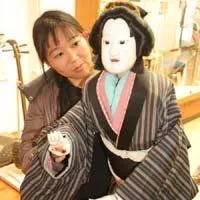
Traditional puppet plays are one of the 'famous' things in Tokushima. Tokushimans boast about their style of puppet theatre in the same way that Australians boast about beaches or people from the Waikato boast about boy racers. The puppets are nearly life size and require three people to operate; it takes at least three years to learn how to operate a puppet well enough for performance. Although the puppeteers are visible, it's easy to get drawn in and start believing in the puppets as real actors.
Later, in Tokyo, I encountered more amazing puppetry. It wasn't where I was expecting: I might as well admit it, I went to Tokyo Disneysea. And there, in a show about The Little Mermaid, I was surprised and impressed by gigantic puppets, some of them operated by robotics, others by puppeteers who were themselves suspended on strings and harnesses.
I found a different way of delivering fantasy when I went to a manga cafe. These are highly evolved internet cafes, ubiquitous in the bigger cities: after paying a small hourly fee, you are assigned a capsule containing a TV, DVD player, internet computer, headphones, comfy slippers and armchair with as many DVDs and manga comics on tap as you can lap up, including the naughty ones. There's free access to a machine dispensing hot and cold drinks, and you can even hire a towel for the on-site showers. Girls pay less per hour (presumably because this will attract more otaku, or nerds). But maybe they're not after the real girls, anyway.
But there are some things that technology can't replace and one of them is the shamisen, or Japanese three-stringed lute. Sounding like a box with stretched rubber bands to the uninitiated, to connoisseurs it is a subtle and delicate sound, indispensable as a traditional art practised by geisha and as accompaniment to Japanese theatre. It's a simple wooden box shape covered by stretched dog or cat skin. Despite attempts to synthesise a replacement material, no substitute for killing dogs (bred specially for the purpose and raised in small cages to reduce damage to the skin) has been found. It was thus with mixed feelings that I sat down to try out the shamisen for myself, under the guidance of one of the few teachers who dared to teach the instrument to foreigners.
Needless to say I didn't even come close to being able to play anything, but I did learn to appreciate the difficulty of playing such a precise and ancient instrument. In a way, the instrument epitomised my overall experience of Japan: extravagant, difficult to understand, often hard to access. But open yourself up and soon you start to appreciate its subtlety, and the way several apparently incompatible elements come together to make something quite incredible.
Related story
Ningyo Joruri - Puppet Theatre
Use the comment box below
15/01/09