Treading Lightly
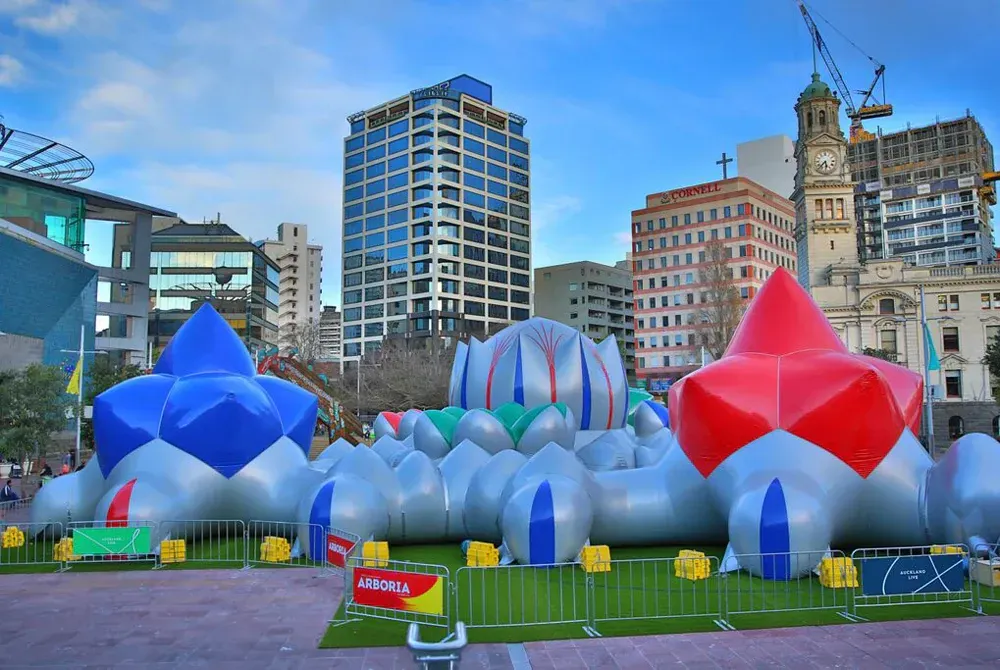
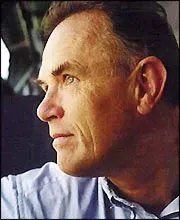
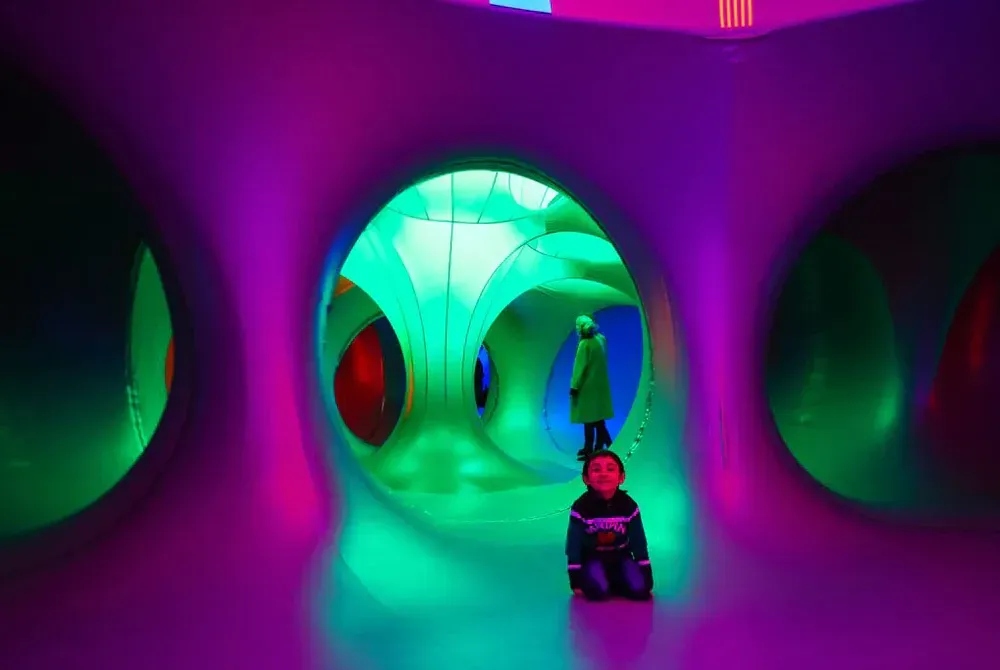
Architects of Air founder, designer and artistic director Alan Parkinson first started experimenting with pneumatic sculptures in the 1980s and has since developed his own language of form in this plastic medium.
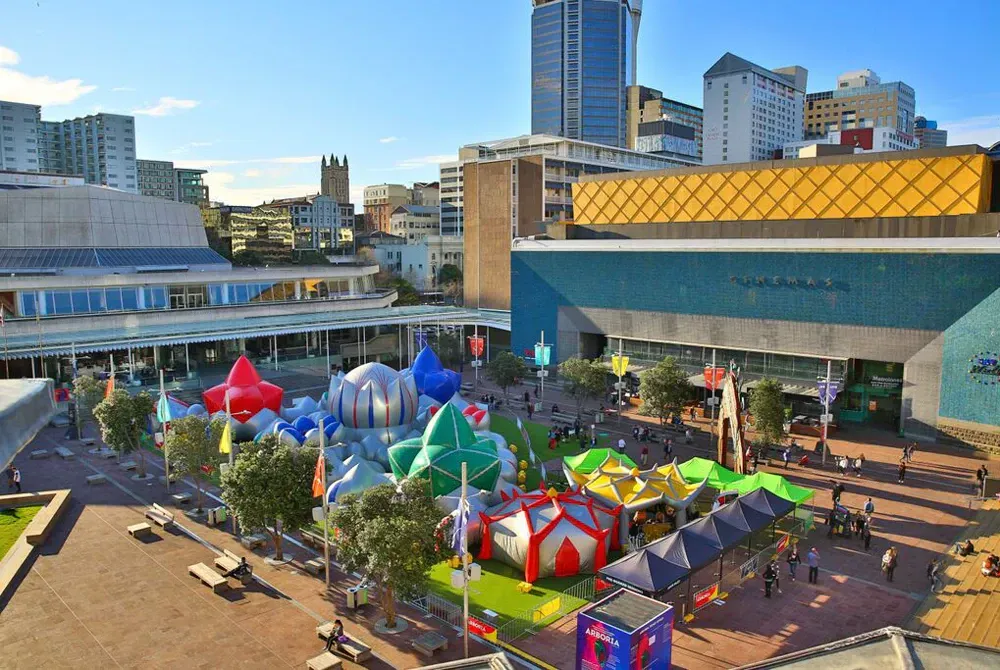
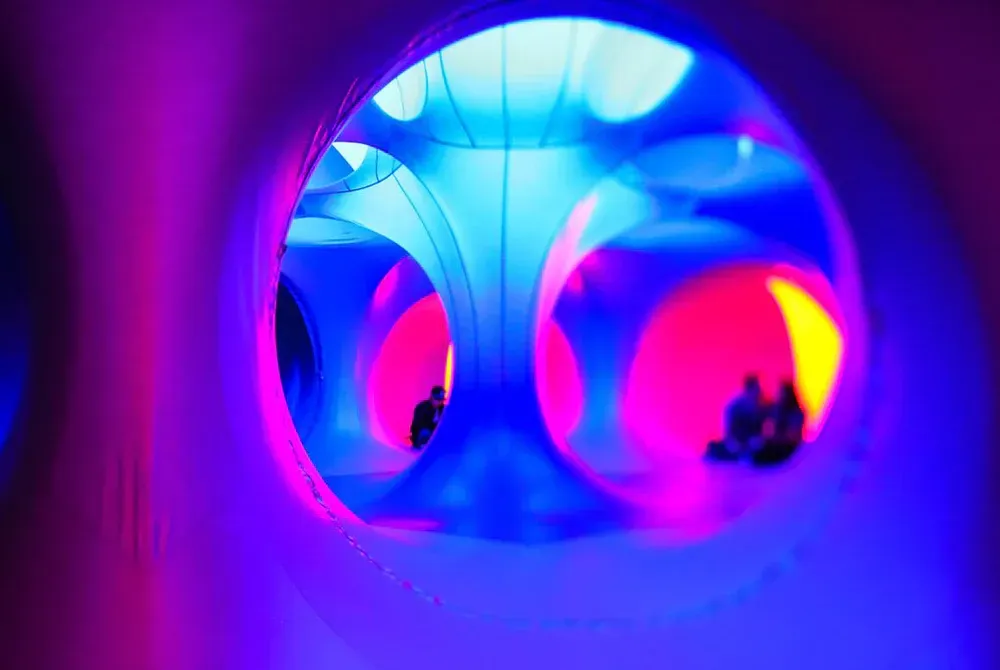
Luminarium inflated maze-like structures celebrating the beauty of light and form – have been created and toured by the Architects of Air for two decades, amassing more than 3 million visitors in 41 countries across five continents. Now Arboria, their newest luminarium, is at Aotea Square for the school holidays.
Renee Liang interviews Alan.
* * *
What inspired you to create the first luminarium?
I saw an inflatable structure on the same principle, ie one that you entered, back in the early 80's (such structures had been around since the late 60's). I was struck by the beauty of the light and wanted to create something similar.
The designs must involve some serious calculations and testing - how long does it take to design one, and what's the process?
The engineering side is pretty rigorous with respect to the precision cutting of the templates that we use to cut out our PVC. Design doesn't happen in a fixed block of time so I can't quantify how long it takes but roughly a structure structure is designed and built over a period of a year. The actual building generally takes about 5 to 6 months.
I've a long answer to the question about design process that I've extracted from the Architects of Air book.
'The starting point for a design is to devise the footprint of the luminarium on the ground. This will be a labyrinthine layout that will afford maximum mystery and discovery when travelling through the structure. The footprint design must be founded on a general sense of how the 3-dimensional forms can be realised in order to be sure that the footprint is viable.
Once a satisfactory footprint is achieved a detailed engineering analysis of the forms and template design can be undertaken. For inflatable structures to have smooth surfaces their shapes must follow the laws of physics as they apply to pneumatic structures. In simple terms this means that the design process breaks down forms into volumes – i.e. cones, spheres and cylinders and their combinations.
Alan Parkinson: “When I begin imagining new forms the process is initially internal, with eyes closed, building a picture of a form, entering its three-dimensionality, imagining the tensions at play. It is necessary to know what are viable pneumatic forms and to have a sense of how pressure will act on the forms when they are combined. Building the structure in my head and then exploring it is an essential step to convince me that I have a viable pneumatic form and that it is something I want to create. From here I can then go to the drawing board."
Until 2010 all the structures were designed on the drawing board, using traditional engineering drawing techniques. Now the forms are being draughted on computer with CAD programmes.
AP “Computer modelling speeds up the process of getting from idea to realisation enormously. However, virtual models can be deceptive as they offer very plausible hypothetical structures that are fundamentally impractical to realise. One has to return to what one has learnt of the materials and stay grounded in their reality.”
The functionality of the structure as a temporary building is a prime consideration in the design process. Aspects of functionality include portability, drainage, stability in windy conditions, accessibility to permit passage of wheelchairs, and a modularity to enable the structures to be reconfigured for different sites. A single skin inflatable structure does not permit a separation of function from form; the same piece of material must work visually and structurally. So functional initiatives are taken whilst ensuring the aesthetic implications of the functionality are consistent with the visual unity of the structure.
Having achieved a viable 3D model of a structure on the drawing board or computer the different elements are then flattened to create 2-dimensional template drawings. These drawings will then be scaled up to make the hardboard templates that are used to cut out the plastic.
The Architects of Air designs have evolved through a process of trial and error, building on the successes and failures of previous structures. Reduced scale models are not made because they’re not truly indicative of how things will work so, risky as it may seem, only full-scale structures are made.'
How much upkeep do they need?
They need quite a bit of upkeep - constant cleaning and repair both on-site and when the structures return from their touring to the workshop in Nottingham. A structure may last from four to eight years depending on the amount of time it is exhibited within that period and the environmental factors it is subject to - eg extreme heat or cold, high UV, atmospheric pollution.
Have you applied what you have learned through designing luminaria to other projects?
The luminaria were my sole focus until I recently started setting up my own pottery workshop. I've not wanted to replicate in clay what I've learnt from luminaria about 3-dimensional design. Working with clay has actually meant giving up the control I've pushed for with luminaria design in order to be led more by the material.
Do you find communities the world over respond the same to your luminaria?
Yes. The experience is so simple that it can be universal.
Have your luminaria ever been used for performance?
Many many times - dance, theatre, and mostly music in many different forms.
Tell me about your impulses behind designing Arboria.
I'd wanted to create a structure with a very large open space at its centre - and to do this I designed a dome surrounded by a circular nine-sided colonnade which in turn was triangulated by three outer tree-like forms. It was these 'trees' that led on to thinking that I'd like to carry through the theme of trees to the rest of the structure even though normally I would avoid making concrete references to real world objects in a structure.
The outer domes have their seam patterns designed in such a way as to create graphic suggestion of different leaf-forms - the style is similar to Assyrian decorative art. The main dome with its colonnade as a foundation naturally gave rise to extending the columns upward and allowed me to return to one of my earlier inspirations - Gothic Cathedrals and in this case it is a specific structure, the Chapter House of York Minster that was the inspiration.
Is there a size limit for your work?
There is no size limit for this type of work - but I've no ambition to go any bigger.
What are you working on next?
I'm developing ideas for our next luminarium, Katena, that we'll build later this year. It will feature the catenary curve in many different manifestations. The catenary curve is the curve of a chain hanging between two points. Gaudi used suspended chains when he designed the Sagrada Familia upside down. The catenary has a visual sympathy with pneumatic forms and I want to push its application as far as I can.