Boggy New Ground
Written by
By Mark Amery
While writers seem to get away with writing one great novel or play in five, we seem to have a terrible propensity to write off a visual artist based on a single encounter.
Yet most artist’s careers will be based not on delivering to familiar expectations, but on always traveling into uncharted territory, whilst following coordinates that are distinctively their own. The risk of being disappointed by one of your favourites with new work is always sizeable.
And so it comes to be that, when I finally get to write about the work of Rohan Wealleans - after years of seeing one knockout show after another - I leave feeling let down.
Since graduating from art school early in the decade Wealleans has given hope to the potential of the old physical craft stuff of the slapping on of, and hacking away at material. His trademark has been finding new high-keyed ways to employ a particularly neat and labour intensive synthesis of painting and sculpture. Wealleans paints objects with what are sometimes hundreds of layers of different coloured paints, creating a surface from which with a knife he can cut and scallop out bulbous shapes from lurid surfaces with strata centimeters thick.
The effect is a composting of painting history from which Wealleans builds and carves out abstract landscapes or bodies with nods to a dizzying array of pop cultural references. These are trapped within distinct organic cultures with knobbly protrusions and rich sedimentary soil structures.
Wealleans’ actions have the aggressive performance of both the sculptor and some fictional tribal space leader, creating totems to serve as communicators with the natural spirit world. Cutting away at, and exposing the flesh of his materials, Wealleans’ works can both speak to our connection to the messy, physical material of being part of nature, and also make you laugh out loud with the hilarious b-grade horror like audacity of their alien animation of our fears.
Except now. The new work in his exhibition NOWON at Hamish McKay’s isn’t connecting with anything other than excessive ornamentation for me - something only highlighted by the strength of the many older works also on display.
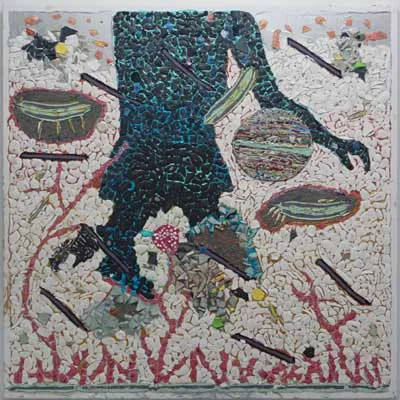
If in swallowing so much paint and trying to create something new out of its regurgitation Wealleans’ work always ran the risk of being excessively rich and shapeless, this exhibition proves that indeed it can be akin to a vomitorium of excavated modernism. It feels like he’s rearranging the deckchairs on that particular Titanic into one final ridiculous arrangement; channeling the worst excesses of neo-expressionism (Wealleans’ scalloping is suddenly reminiscent of Julian Schnabel’s blasted broken plates).
He does all this with such craft and zeal there’s much to admire, if not enjoy. I respect there’s a necessity to the pushing of his ideas and materials into new ground, but that ground here turns out to be boggy rather than fresh.
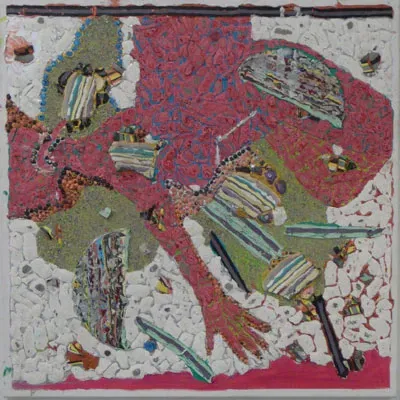
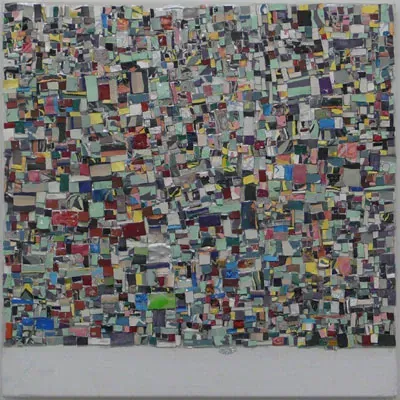
With a series of works on canvas, Wealleans’ transformation of painting into sculpture sees it almost returned into painting again. Swollen shapes are replaced by an exploration on the flat of surface texture, with the arrangement of an incredibly varied range of material created from dried acrylic (like some beachcomber arranging wood, sand and shell). The strongest for me is Square Brainy. From a distance it’s a dazzlingly square of licorice allsort shards of chunks of striped paint, with a nod to the decorative sculptural reliefs of 1950s architectural modernism. Close up however it’s a messy decorative arrangement with little beyond visual impact I can find to say for itself. Meanwhile with their fluid figures, Angel Gun and Stirry Stirry Sky evoke Pat Hanly’s Figures in Light series, but with none of their clarity of purpose.
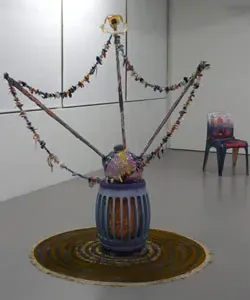
Of several sculptural arrangements the largest is Deep Purple. It resembles a shrine (slivers of paint hang from threads like prayer flags) with a purple domestic furnace containing a large red paintball and some form of power-giving crystal placed in a blotchy bloated ball on top. Yet while Don Driver’s assemblages of materials (also shown at McKay’s) manage to evoke disturbances with our connection to the land, with wit and intimations of otherworldly rituals, Weallean’s evokes a hippy crosscultural object of devotion in a market that has seen a few too many Acid-soaked experimental art workshops.
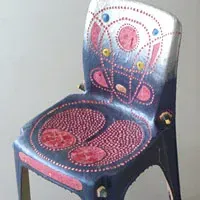
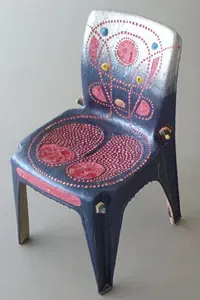
Only one recent work stands out with the brilliant coherence of craft and humour I’m accustomed to in a Wealleans’ exhibition. Martian Chair is a common plastic chair that has been pimped out into something extraordinary, acrylic paint subtly built up and then carved away from the surface. It is as if to sit on this modest throne you might engage in psychic pop travel powered, believe it or not, through the cheeks of your bottom.
Rohan Wealleans NOWON at Hamish McKay in Wellington, until September 26.