The camera as a gate
Written by
By Mark Amery - Originally published in Massey Research Magazine, 2008
Consider if you will the camera as a gate. A gate providing access to other worlds through the walls that bound our current experience of the world.
Be it 19th century spiritualist and landscape photography, or 20th century war and celebrity photography, photographers as gatekeepers have negotiated access to spaces on our behalf.
Yet photographers also frame up those spaces for us. They not only open space up to us with light, they define our view, and work to articulate something out of what they have found.
Now consider that the university researcher acts in a similar way. They open out new fields and direct us to look at those fields from a certain perspective.
Artist Wayne Barrar’s photography has always been both art and research project. International contemporary art practice has in recent years moved ever closer to Barrar’s longstanding interest in photography as a research tool, making him a natural leader for the creative research work of Massey’s School of Fine Arts.
Barrar is Director of Photography at Massey, and the school is at the forefront nationally of treating contemporary art as a field of creative research. One of this country’s most notable photographic artists, over several decades Barrar’s own practice has explored concerns we associate more readily with scientific and geographic research.
From Wanganui riverbank retention and a visit to the phosphate-mined landscape of Nauru, through to his current forays around the Waikato to look at koi carp infestation, Barrar has an enduring interest in the complex relationship between culture and nature. His photography has provided a fascinating ongoing discussion about the way we contain and shape nature and landscape, and in so doing become part of our environment. In turn each image mirrors this discussion by considering the way a photograph as a chamber frames and contains the world.
The fine art outcomes are strong and diverse, from solo exhibitions such as Landscapes of Change in 2001 at the Nevada Museum of Art in the United States, and the University of Otago Press published survey of Barrar’s work, Shifting Nature, to smaller suites of works in prestigious exhibitions like biennial national survey show Prospect 2004 at City Gallery Wellington, and the International Museum of Photography and Film (George Eastman House, Rochester, USA) exhibition Picturing Eden, which has been touring in the United States since 2006.
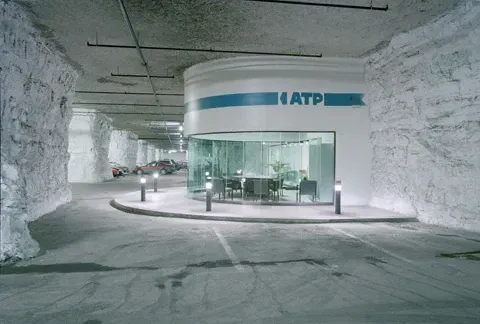
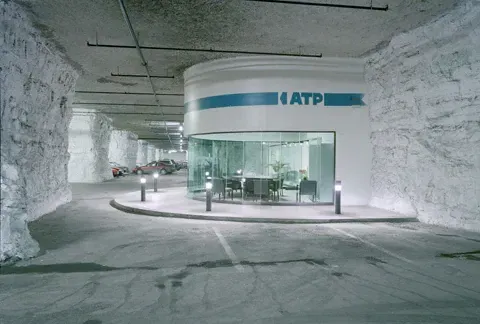
Barrar has recently completed his biggest research project yet, a look at commercially mined underground spaces and how they are put to new uses when the mining stops. The project took five years and saw him visit working and reused mine spaces in America, Australia and New Zealand.
“I was struck by how these underground environments are normalised for people, and the way things are arranged to make them feel at home there. I was also interested to explore the way that underground spaces are commodified. It hadn’t occurred to me before that underground areas could be used in this way, as a sort of subterranean real estate.”
In the United States Barrar photographed an enormous underground car storage facility, a university which mines out spaces underground as it expands, the world’s largest mushroom farm, a space which will store nuclear waste from the Cold War weapons programme, and an underground paintball arena (the carcasses of the exploded balls leaving a field of abstract pop delight).
“Some re-uses appear almost counter-intuitive at first, like the former salt mine that has proved to be an ideal location for a film archive. You imagine that a salt mine will be a corrosive environment, but the reality is that it is almost inert.”
Disused mines have also proved appealing sites for commercial office space. There are not only economic advantages (why build structures when spaces lie vacant?) but the environment provides minimal distraction for employees and security is more easily handled.
“Mining sites have limited access, often a single portal or shaft,” Barrar has written. “They represent private rather than public spaces, able to be promoted as places of exclusion. In a sense, an underground industrial park such as Subtropolis in Kansas City, Missouri is the ultimate gated community.”
Barrar is interested in how these restrictions lead to highly controlled, aestheticised human landscapes within rock. While each site’s dramatic lighting and unusual natural architecture provide the framework for Barrar to take striking photographs, at the centre of each are the ironies of how we order the underground world to represent above-ground.
The photographs play on the conflicting feelings we have about control underground: a place of shelter and refuge, but also a place of burial and limited escape.
These responses are minimised by reforming the environment to make it as close as possible to the above-ground. However, Barrar came to recognise consistent features in underground offices, like the retention of a natural rock wall. “You’ll usually find a signifier of the underground. You’ve got everything finished except they leave one little bit to remind you of where you are.”
With working mines Barrar’s interest was particularly in those chambers where workers seek some respite from the earth: fully lit crib rooms where the workers have lunch, the ‘refuge cuddy’ and emergency life support chambers. Huntly coalmine has a makeshift New Zealand variation on a crib room - a chopped up container.
“They normalise these spaces. Workers leave their marks and it’s a form of territorial placemaking.”
Another tangent of this project is a series of black and white photographs of underground homes at Coober Pedy, South Australia. Originally these homes were converted opal mines, but are now planned dugout pockets of suburbia. They’re attractive real estate because they offer respite from the extreme temperatures of the desert above. Again there are a number of economic advantages (“in constructing a new bedroom, you get the chance to add to your income through opal extraction.”) Barrar’s series also shows underground facilities like churches and a hotel complex.
Barrar’s photography has always played on the incongruity of things that seem to be in the wrong place. Here it’s the insertion of domestic furnishings and architecture into rock faces. Barrar’s camera soaks up the unusual aesthetics underground, with strange plays of light and an unusual confluence of textures.
It’s clear he also relishes the technical challenges. Electricity is expensive at Coober Pedy, so he found himself photographing in 40 watt lightbulb environments. Barrar’s image of an underground hotel bar isn’t just surreal because of its context, but because of the eerie glow from a jukebox in the dimness, and the soft light spilling across the rich scarred surface of the rock walls.
“People are essentially recreating a familiar suburbia here, rather than being responsive to the particulars of the environment. I mean look at this,” he says, directing me to a photograph of the entrance to an underground house, “you’ve got this almost Sydney suburban frontage transplanted onto the outback. Again, there’s this normalisation process going on.”
This project has also been out of the ordinary because research around the reuse of underground spaces has been rare.
“There are very few books on this issue. While there’s been a few commercial things done photographically there are no art based projects of any note engaging the underground. That’s why I’ve always positioned this as a project with international interest.”
Barrar was interested in ensuring he had a variety of samples, rather than collecting as many underground sites as he could.
“A year or so ago I knew I’d shot enough because I felt I’d collected enough aspects and ideas around these spaces as commodities. A key aspect of the project is the fact that this is globalised space; there’s a real tendency for these sites to be similar, wherever they are in the world.”
Barrar is opening gates to allow us to see new landscapes, but gaining access isn’t automatic. In fact, he says, the process of obtaining access and permissions is a thread that runs through his recent projects.
The underground series is yet to be exhibited in its entirety, though images have appeared in various exhibitions to date. However, the extraordinary nature of his research has also meant presenting in other contexts. In 2006 he presented a paper at Going Underground: Excavating the Subterranean City, a conference at the Centre for Sustainable and Renewable Futures (Salford and Durham Universities) in Manchester.
“This is an arena I like crossing over into, which is interdisciplinary and a broader cultural practice. That’s a mode of operation I’m comfortable with.”
II
Barrar’s current project focuses on biosecurity - the boundary between the native and exotic and the complexities of how it is controlled in New Zealand.
Photographic assignments thus far have included a visit to a DOC lake poisoning operation in Whitby to get rid of invasive noxious fish species; a secure quarantine facility at Lincoln testing biological control agencies (flies are put in to eat weed species to see if they can be released as biological control agents); and, would you believe it, the national algae collection in Nelson.
“Algae is being kept alive in a constantly monitored secure facility, and it takes daily attention to keep it going. It’s a reference library, so when there’s a toxic algae bloom they have something to compare it against.”
Largely New Zealand based, the project is in its early stages and Barrar thinks it will keep him busy for the next three years. The project is totally integrated into his Massey work, funded by small grants, and when he is out on assignment he is representing Massey with research outputs for the university.
It involves ongoing negotiation and contact with organisations to obtain access to different facilities and activity. “As with the underground sites, you can understand their concerns,” Barrar says. “There are often issues such as security and intellectual property that need to be taken into account, so I need to be absolutely clear about the sorts of things I’m interested in photographing, and why.
“Once they get a sense of what I’m doing and see some of my other work, they’re usually fine, and in fact can get quite excited because it’s quite novel to have someone approach it in that way. In many cases, there is also an educational component to what they’re trying to achieve, and they’re aware that my work can feed into public awareness of the issues. I also make the work pretty freely available for dissemination for people doing research.
“Being based at the university is an advantage, because they understand that people research visually now. It’s a good time to be doing this work.”
Barrar has a grounding in science as well as fine arts, with his first degree having been a Bachelor of Science in Zoology. “I don’t think of myself as a science-photographer, but that grounding certainly helps in terms of understanding what these scientists are doing. I think this sort of crossover and interdisciplinary work is really appropriate for work coming out of a university in a fine arts context.”
A look at some fresh prints shows Barrar’s interest remains aesthetic as well as scientific. He has a keen eye for how we organise laboratory spaces as interiors and landscapes.
“This project is quite interesting to me because I hardly ever used to photograph interiors until I did the underground works. It’s now almost interior landscapes that I’ve become particularly interested in - as a close view of an encapsulated nature.”
A commonality across this and the Subterra project is Barrar’s interest in globalisation and the breakdown of borders. While this new project is largely nationally based there can’t help but be international strands. He loves the irony for example that Pohutukawa grows so well in South Africa that it’s considered an invasive species.
What Barrar dubs a subproject is research into the explosion of koi carp in the Waikato. It’s again a subject full of ironies and complexities around something being in the wrong place. A fish he says is often dubbed “the possum of the waterways in New Zealand” is conversely highly revered in Japan, where a prize fish could fetch $100,000 at auction.
“All around the world there are competitions and fanatical collectors of these massive fish, yet in New Zealand they are at the other extreme in terms of social value. They just have such a devastating effect on our waterways. There’s a containment area you’re not allowed to move them from. They’re a serious problem.
“I find it interesting to be concentrating on something which might seem as meaningless as koi carp but where there is actually a major international story there around the movement of an organism.”
Barrar is also in the business of storytelling – the camera is no objective collector of data, it has the freedom to capture beautifully what statistics or words can’t show as dynamically.
Take the koi. Barrar talks of portraying the ‘Koi Carp Classic’ sponsored by DOC, a weekend in the Waikato whereupon people come together annually to remove about six to nine tonnes of the pest from local waterways. Barrar has documented the process, from the bow-hunting of the fish and the trophy-boards to the recycling of the koi into burley.
“One of the things I’ve photographed is sequences of these dead koi as they fly through the air, balletic – thrown into ‘Stormin’ Norman’, a machine that crushes them and turns them into a pulp. People actually back up whole trailers to get them filled with the pulp, poured straight into the trailer, and they head off down the road with this stuff wobbling around.”
Barrar’s interest in photography and science have paralleled each other since childhood.
“The first camera based thing I did was buying a camera that took photographs down my microscope. I started making circular images of things that interested me, so there was always that aesthetic interest as well as the interest in science - and experimentation with microscopes and equipment and so on.
“Even when I was at university studying zoology I was involved in a very active photographic society, as PhotoForum was in the 70s. In those days most people didn’t go to art school like Elam or Ilam to do photography. But there was an independent photography scene and I used to look forward to reading the latest issue of the classic British journal, Creative Camera, in the public library.”
Barrar joined the staff of the former Wellington Polytechnic in 1998. Massey University's School of Fine Arts was established in 1999 - Barrar helping develop New Zealand's first photography department within a Fine Art programme.
Part of the department’s reputation lies in its roll call of outstanding photographic artists on staff with a proven interest in research. Alongside Barrar are Anne Noble, Ann Shelton and until recently Gavin Hipkins – all among New Zealand’s most recognised artists.
“Creative based research is no longer a luxury or an add-on, it’s become an integral part of the university and we’re accountable for our research. There’s a long term academic focus on creative based research, which is what we do here with the government initiated Performance Based Research Fund - rewarding excellence in research activity.
“That’s why I say the projects that I’m doing are so in line with university research and they make up a significant part of my work. The time that artists working in universities have for their research can help them push boundaries and undertake projects that maybe aren’t typical.”
Barrar’s lifelong interest in photography and science also meet in his research interest in photographic technology and history. As well as collecting historic prints he has worked across an eclectic range of formats, with an interest in non-conventional printing processes and how they provide a different dimension to the photograph’s subject, from the 19th century cyanotype blue print to the salt print.
These days Barrar’s practice is mostly digital and he laments that working in black and white and printing is getting harder because of getting the materials. Soon he won’t be able to reprint the Coober Pedy work as he intended because the company that produces the photographic paper has gone bankrupt.
Barrar considers an important component of the research work at Massey the attention being paid to excellence in digital printing, and the difference looking at some of Barrar’s recent large format prints compared to other large prints I see exhibited is very clear.
This is an area Barrar says has developed significantly in recent years at Massey.
“The quality of those prints is fairly outstanding because we’ve tweaked and worked the process. Even though the machinery isn’t much different from what you can buy to use at home, the support of our highly skilled technical staff means you can print high resolution work with real control, often to a level far beyond normal commercial standards. In exhibition photography that’s really important.”
When I see Barrar he’s about to head back up to the Waikato to do some landscape photography around the koi carp containment area (it stretches from Helensville, northwest of Auckland, to Otorohanga).
“There’s also quite a nice case study there. There’s a giant weta, the Mahoenui, that was almost extinct and they found some of them in a patch of gorse in the King Country. What’s really interesting there is that it’s a pest, the gorse, that has protected them.”