The Sacred and Profane
Written by
By Mark Amery Courtesy of The Dominion Post
By Mark Amery Courtesy of The Dominion Post
If ever there was an artist I never expected to find exhibiting in a church it is Terry Urbahn. True, previously as a project manager for New Zealand at the Venice Biennale he has installed contemporary art in a number of historic sanctified spaces (he is currently coordinating Australia’s 2009 representation). Yet inviting Urbahn to exhibit in a church would once have been the equivalent of the Dean ordering up a string quartet and getting Head Like a Hole.
Which turns out to be why Urbahn’s installation The Sacred Hart seemed more apt in Auckland’s St Matthews in the City last week than now in the Wellington Film Archive’s cinema (showing care of the Auckland Festival with an accompanying small retrospective). Be it surfing, drinking or guitar-playing Urbahn has made an art practice of mashing up together like radiowaves the profane to consider it as sacred and worthy of meditation. That in the pub and low rent hotel there are the rituals and iconography of communion, both empty and meaningful, for people of all walks of life.
For The Sacred Hart Urbahn gathered together in the public bar of New Plymouth’s White Hart Hotel an eclectic range of local identities with stories embedded in the bar’s history from the last 40 years for a last supper. He celebrated the hotel as a place of bikie gangs, rock gigs and artist interventions (the Govett Brewster, where Urbahn once worked, is across the road), paying homage to what is clearly for him as a site a formative creative influence.
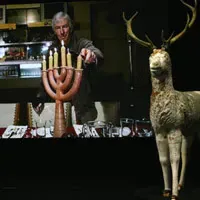
In a smart moving variation on the Da Vinci church fresco, over two and half hours a camera slowly and evenly tracks up and down a long table, capturing the guests on the other side as they eat and drink, swap stories and talk memories, local politics, media and art, their voices falling and rising from the surround sound. In a nice touch artist Don Driver lights the candelabra. At St. Matthews coloured light spills across the screen from a stained glass window designed by Urbahn’s art school teacher Philip Trustrum.
Next to the screen in both cities a replica of the white stag that adorns the pub’s roof rotates slowly on a platform. Urbahn has taken from up high the pub’s version of a cross, reinvesting in it the symbolism a white stag has had in folklore for thousands of years as a sign of the otherworldly. Curiously, one limb has become a human leg and foot. It strikes me as I watch the video that this serves as a reminder that when we tell stories we engage in the act of turning memories into mythology, of personal perspectives becoming universal lore.
One of the joys of Urbahn’s sound mixing is how it gives equal weight to all the stories, even if tellingly the one journalist in the room (TVNZ’s Mark Crysell) has the loudest voice. As the accompanying retrospective also makes clear, Urbahn’s art suggests that the remnants of the lives lived close to us bear more philosophical attention from artists and priests than abstract notions and marks.
The Sacred Hart feels like a big step up for Urbahn. It has a clarity that welcomes you to follow different threads through the complexity of the work, rather than getting you tangled in a post-punk jagged medley of visual layers, as he has sometimes in the past.
Not that the accompanying retrospective isn’t well deserved and rewarding (a bigger overview is overdue at City Gallery), but it look like emergent experimentation by comparison. Urbahn has sensibly picked out a path through his work that brings us to The Sacred Hart. Principal are his excavation of stories and detritus from the last days of another down-at-heels icon, Cuba Street’s Columbia Hotel. Unlike The White Hart it was closed before it could attain historic status, and instead Urbahn wove stories from the evidence that remained of the frustrations of looking for meaning in life.
Urbahn places power in the icons, temples and texts he has grown up with. And whether its a security cam video of Urbahn as a suit and tie man finding companionship with strangers and pints of beer in a bar, or his posters of the artist as a series of clown-like rock archetypes, he lingers on the futility of our desire for the mythical and unreachable rather than what is in front of us.
Terry Urbahn Selected Works 1994 – 2008 The Film Archive, Wellington, until May 9